Spending and your body, side by side
See what your body was saying when you spent.
Most money apps count what you spent. Veyla asks what was going on. A short night, a long day, a racing heart: how you feel shapes how you spend. Veyla helps you notice it, without budgets or blame.
- ✓ No budgets
- ✓ No grades
- ✓ Nothing to fail
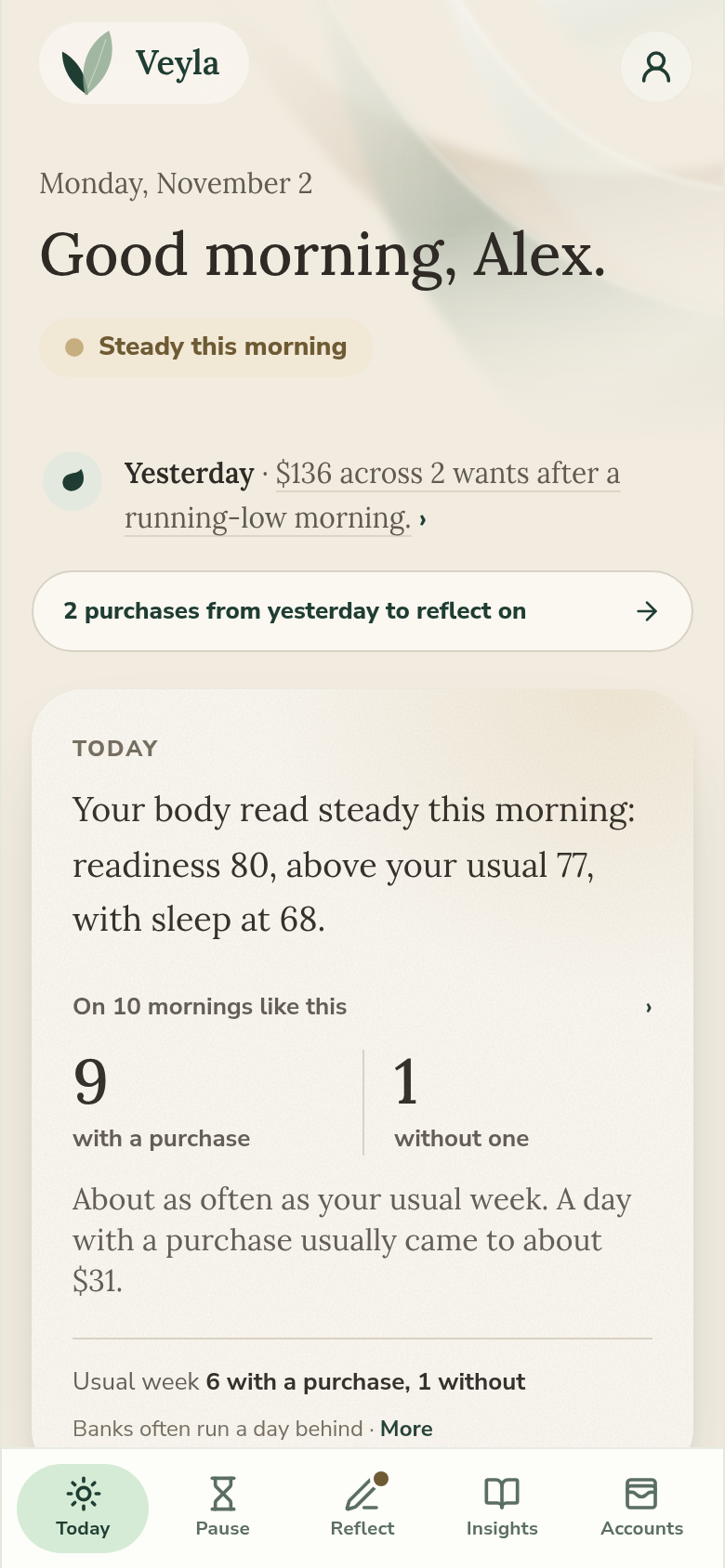
The real app, shown with sample data.
The problem
Most money apps count what you spent. Few ask why.
The splurge after three nights of bad sleep.
The order placed after a hard day.
The gift you bought because you felt great.
Those moments are invisible to a spreadsheet. Budgets show how far over you went, then leave you to feel bad about it, and guilt rarely changes what happens next time.
It’s not a willpower problem.
Setting budgets didn’t reduce spending.
In a 13-week study of 9,000+ app users, setting numeric limits increased app visits but didn’t change how much people spent.
Spending is often coping.
4 in 10 Americans say they spend to cope with emotional highs and lows.
Money weighs on most of us.
Money is a significant source of stress for 65% of adults.
Veyla doesn’t give you another limit to fail. It shows you what was going on when you spent.
The idea
Your spending and your body, lined up.
Your spending
From the cards you link, read-only.
Your body
Sleep, readiness and heart rate from your wearable.
The story behind each purchase
What was happening before and after you bought it.
How you slept, how rested you were, what your heart did in the hour before you bought something: they're all clues. Veyla sets them beside your purchases, then asks how each one felt.
What Veyla can find
Here's the kind of thing Veyla noticed in one sample person's history:
On mornings their readiness was 76 or below, they bought something about 50% more often: 9 in 10 days, against 6 in 10.
Online shopping stood out. A week later, they were still glad about only 1 of 7 of those purchases.
Everyone's story is different. Some links jump out in your first few weeks; others are quieter rhythms that take time to surface. Veyla never invents a correlation that isn't backed by your data, so whatever you see is honest and grounded.
How it works
Small rituals. Quiet noticing.
Each morning
A short daily ritual, not a dashboard.
- How this morning looks Restored, Steady or Running low, straight from your wearable.
- Yesterday, gently What you spent, and one tap on how the evening felt.
- An intention for today About how to spend, never how much.
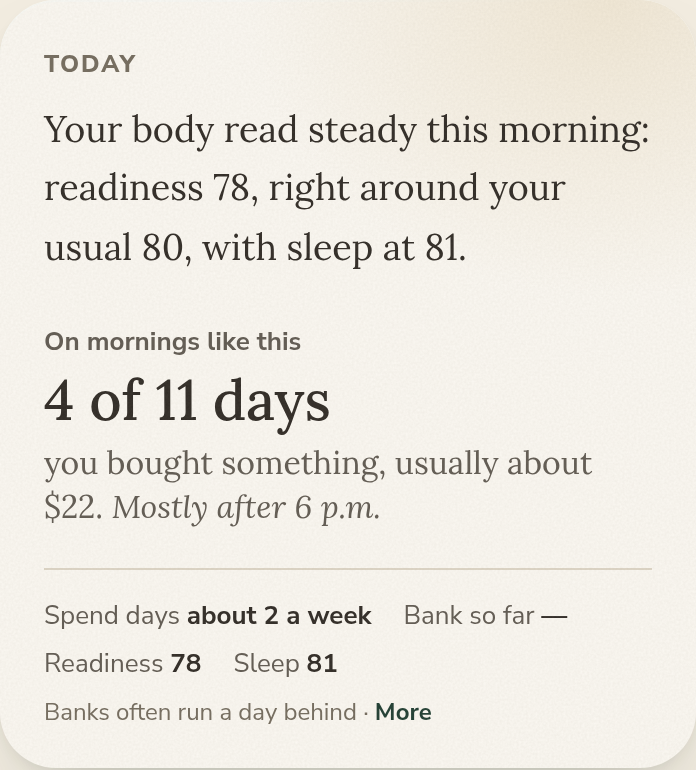
Your week
Seven days of body and spending, in one picture.
- The ridge is your morning readiness, from your wearable.
- The bars are what you spent on things you chose, not bills.
- Honest gaps. A day your bank hasn't confirmed shows a dash, never a made-up $0.
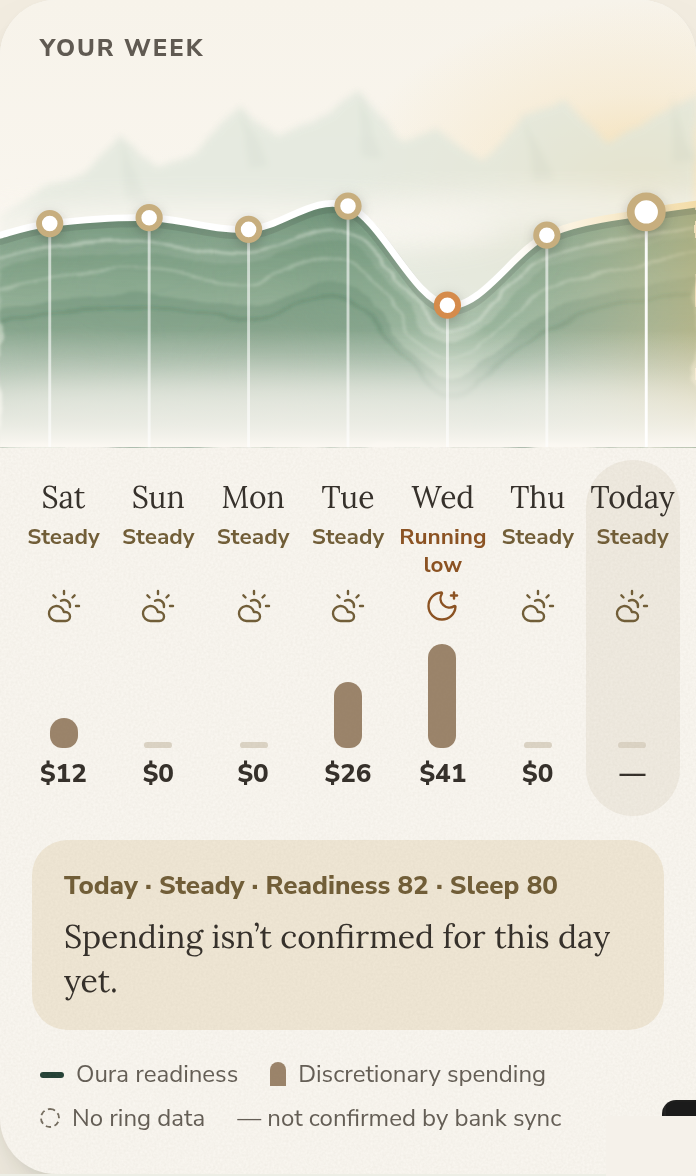
Reflect
One purchase at a time, while the moment is still close.
- The question comes first. How did this one feel? Your body's data waits, so it doesn't shape your answer.
- Then the context opens. That morning's energy and how your heart moved in the hour around the purchase.
- Every purchase keeps its own answer. Two buys minutes apart can feel completely different.
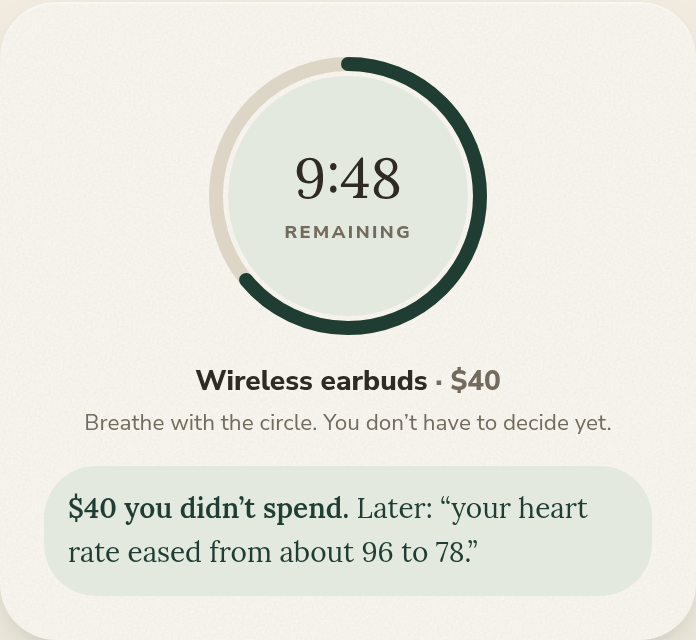
Pause
A pause instead of a budget.
- Name what you want. Then wait 15 minutes, an hour or a night.
- When the timer ends, Veyla asks how the want feels now.
- Pass, or buy it. Either is okay.
Patterns
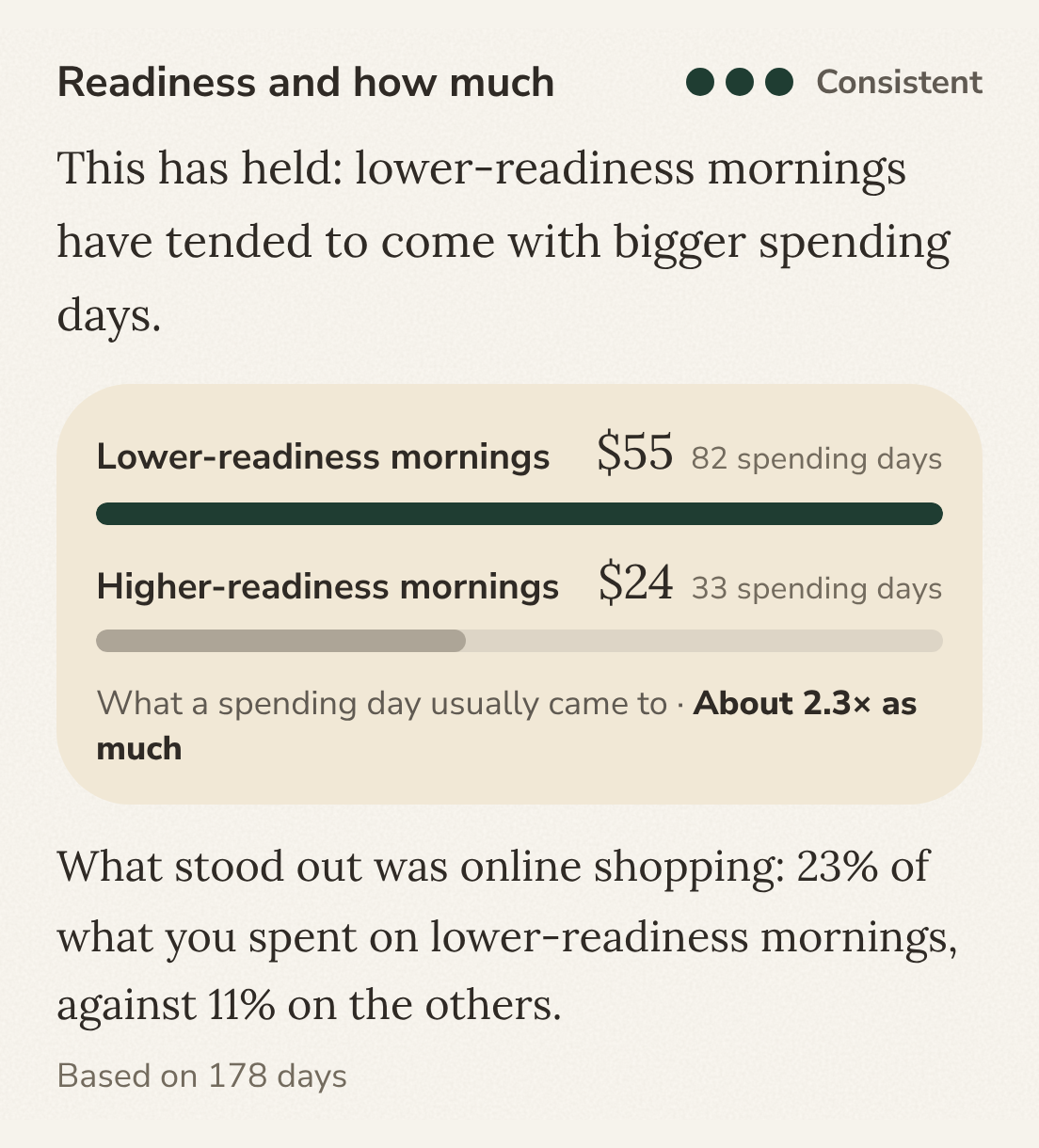
Your own patterns, in plain numbers.
- Checked thousands of ways to rule out luck.
- “Consistent” only when older and newer days agree.
- When there's no link, Veyla says so.
Screens shown with sample data from the Veyla demo account.
What Veyla won't do
No shame, no scores, no telling you what to buy.
- ✓It won't set budgets or grade your days.
- ✓It won't guess why you bought something. You tell it.
- ✓It won't call a link a cause. It says “nothing clear yet” when that's the truth.
- ✓It won't sell your data or move your money.
Privacy
Your data, used for one thing: your story.
Connected safely
Banks link through Plaid, read-only. Your wearable connects through secure, official integrations.
Only yours
Each account reads only its own data. The keys to your bank and wearable stay on the server.
Gone when you say
One step disconnects your bank and wearable and deletes everything Veyla stored.
No ads, and your data is never sold. No AI ever sees your body or spending data; your weekly reflection is written by Veyla itself, from your own counts and words.
A note from the founder
Most of us were taught that money is a math problem. Spend less than you earn, stick to the budget, try harder next time. And when it doesn’t work, we blame ourselves.
I don’t think it’s a math problem. What we buy is tangled up with how we feel, how we slept, and what kind of day we’re having. That isn’t a failing. It’s being human.
I built Veyla so you can see that side of your spending without guilt or shame. Once you can see it, you can understand it.
Let’s make peace with our money.
FAQ
Quiet answers.
Which devices does Veyla work with?+
Veyla currently gathers readings from Oura rings and Apple Watch, with support for additional wearables planned for future releases. If you wear another device or nothing yet, tell us when you sign up so we know what to build next.
Can Veyla move my money?+
No. Bank connections are read-only. Veyla can see purchases; it can never move money.
Will Veyla tell me what I did wrong?+
No. There are no budgets, grades or streaks. Veyla shows what was going on, and you decide what it means.
What does the beta involve?+
About two to three months of using Veyla. You'll need an Oura ring or Apple Watch and a US bank card, and it runs in your phone's browser. If you'd like, a short survey at the start and end, and a 20-minute chat. Both optional.
What you'll need
- ✓An iPhone (Veyla is in beta on TestFlight)
- ✓An Oura Ring or Apple Watch
- ✓A bank or card account to connect, read-only
If you've worn your ring or Watch for a while, Veyla reads your history, so your first findings can show up in days, not months.
No budgets. No grades. Nothing to fail. Veyla never moves your money, never sells your data, and no AI ever sees your body or spending data.
Veyla
Your spending has a story. Start noticing it.
Link a bank and your wearable, and Veyla fills in a little more each day.